Thursday, July 05, 2007

Concept :: Why SMI-S compliance ?

Many of us know what SMI-s means and what it does ? But how important and relevant is the compliance of SMIS in today's times ? Well it is very important. The primary reason being heterogenous storage systems and varied product lines from different vendors that demand compliance from a centralised storage standard. This standard needs to works across various channel technologies and vendor specifics.This standard is essentially SMI-S or Storage Management Initiative Specification that works with these variations.

Essentially SMIS is an object oriented API for managing storage resources on a SAN (NAS included).THE SMI-S API's have base classes that represent common properties that all vendors share.The vendor provides interfaces to the outside world to access information on its product through SMI-S and this is called SMI-S compliance.SMI-S can collect data about a huge category of SAN components that include HBA's,Hosts,Switches,Disk Arrays,Tape libraries etc.

SNIA has a program called "CTP (Conformance Testing Program)" . Vendor products need to pass this test to acquire a SNIA-compliant mark for their product.More details at www.snia.org

Coming next : How does SMI-S increase efficiency of Storage Mgmt Software ? , SMI-S terms

Monday, June 04, 2007

Concept :: More on Linux Multipathing


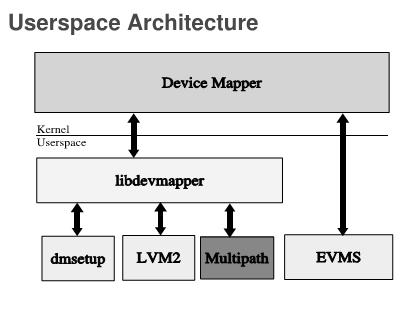
This is how the EVMS and LVM2 interact with the Device mapper . EVMS(Enterprise. Vol Mgmt System) and the LVM2( an extension to Logical Vol Mgmt System (LVM) for 2.4) are user interfaces to interact with the kernel on logical device mgmt.

Basic SCSI terminologies around multipathing:

Physicalpath -> Unique combination of a SCSIinitiator and a SCSItarget,

Device -> SCSI Logicalunit ,

Path -> Logical Connection along a physical path to a prticular device.

Also read - > multipathing user-space tools like multipath , dmsetup , dmraid , udev , hotplug.

Monday, May 14, 2007

Analysis :: How does SMI-S increase efficiency of Storage Management Software ?

SMI-S(Storage Management Initiative-Spec) facilitates three very basic tasks that almost every SAN Mgmt Software needs to provide :

a) Discovery -> Discovery of SMI-S conformant devices from a SAN mgmt server.

b) Monitoring -> The SMI-S client can gather status about each device like health , fault management checks etc.

c) Control -> An SMI-S client enables an IT administrator to actively manage devices in a SAN. For e.g. LUN masking , LUN mapping provided the client has Access Control to LUN's from those host FC ports.

Apart from this , SMI-s facilitates a lot of other services like Multipathing , Copy Services that provide a standardised way of going about things.This standardisation increases efficiency and productivity for vendors who dont need to write vendor-centric or applications using proprietary protocols anymore .

Monday, April 09, 2007

Analysis :: Who's doing well and who's not !

IBM , HP or EMC ??


IDC reports on storage growth
For all the bluster from IBM that accompanied IDC's storage hardware report, the worldwide quarterly disk storage tracker for Q1 2007 from IDC told the same old story: EMC in the lead in the storage market with revenues of $912 million, virtually even with the same quarter last year (where IDC shows its revenues at $911 million).

Hewlett-Packard (HP) lost 1% in revenue, but topped IBM in second place with $575 million in revenue. However, in terms of market share, IDC put HP and IBM in a "statistical tie" at 13.4% and 12.7% revenue share, respectively. EMC was sitting pretty at 21.2% market share but IDC also gave it some bad news. Systems costing less than $50,000 accounted for the majority of the overall market's 5.9% growth from a year ago to $4.3 billion in revenues, according to analyst Brad Nisbet, who was quoted in a press release.

Thursday, February 08, 2007

Concepts :: gGlossary pick

Appliance - A network product designed to perform a specialized task with minimal user administration . In storage virtualization , an appliance is an embedded virtualization engine attached to a SAN.

Block level addressing - An algoithm for identifying blocks of data stored on disk / tape by number. Also known as Logical Block Addressing (LBA). Block address numbers are converted to physical locations on storage such as cylinder , head , sector for disk media.

CDB - Known as SCSI Command Descriptor Block. Used to transfer commands, status, data between an Initiator and Target through SCSI.

Friday, January 12, 2007

Concept :: Server Virtualisation from Vmware !

Hey guyz ,
Server Virtualisation has been a hot buzzword for quite some time after it emerged in the early 2K's and then went into hibernate mode for a while.But now , its hotting up even more after EMC's acquisition of Vmware and , the controversial teaming up of Xensource with Microsoft pumping up a lot of furore from the open source community. But all said and done , what is Server Virtualisation from an amateur's point of view ? Well here's it.

Server Virtualisation is basically virtualising systems and consolidating hardware for better resource utilisation and maximising ROI,TCO(return on investment,total cost of ownership) . Sounds too jargon'ish ?? Hmmmm..Well in simple terms , imagine ten hardware systems hosting ten different platforms with each one running enterprise server roles. What if you had to consolidate hardware and run these 10 platforms on one/two hardware systems. Well , your fist answer would be "How about configuring a dual/quadra boot" ? Nice answer , but if you had to have all the systems up and running enterprise server models simultaneously , your answer falls flat.

The solution to this problem is :-> Server Virtualisation.

So how does it work and look like ? Well , we have more than one virtualisation vendors and its difficult to take all of them up here. But let me take the example of one of the leading(if i may say) virtualisation vendors,Vmware. Vmware has around 8 years experience in the field of virtualisation and are now a part of EMC(one of the leading storage vendors). So how does it work ? Well, there are two models to the Vmware virtualisation strategy

1 . Their virtual infrastructure that runs on a bare metal and doesnt need a host OS.This is called as the "Vmware ESX server". I would say ,this is server virtualisation in the purer sense , as it directly virtualises system services with the hardware. So this will essentially have an ESX Server running on Intel/AMD/etc and will run one or more instances of windows/unix/linux/mac etc as guest OS'es.

2 . Their virtual infrastructure server that runs on a host OS(Win,Unix) and relies on the host OS services for virtualising services within Guest OS'es. This is their older virtualisation model and is called Vmware Server / GSX Server.

So how does this work ? The Vmware infrastructure virtualises each of the services (Processor , RAM Memory , Storage , Networking , OS Services ) to each of the guest OS (virtual machines) as if they were directly accessing these services provided by the hardware.Give a thought to how this can be done .If not , wait for my next article :) .

How does this look like ? Well , i am attaching two snapshots that display two virtual machines running within my host SuSE OS.This is the Vmware GSX Server model(although it runs thru Vmware workstation).The first screenshot shows a Fedore Core 4 desktop(with a "gnome-terminal" opened) running as guest OS while the second shows a Windows 2K3 Server(hope u can c the windows explorer there).


Interesting , right ? Hmmm ,,watch this space on more on server virtualisation .Will look to throw more light on other suites in this space - Xen , Zones etc ...

Saturday, December 16, 2006

Back to blogging !

Hey folks , 
             I have been out of tech blogging for a while but promise to b rite back 
 peddle from now on .. Hope to be back on the storage circuit on topics like 
 Virtualisation , Network attached storage ,  SMIS ... Watch this space for more ....

Sunday, November 19, 2006

News :: EMC to provide data classification for files without the use of agents

EMC is hoping to make the most from its acquisitions of Legato , Documentum and Smarts to deliver a significant product ( one of its kind ) . Read more here ->

http://searchstorage.techtarget.com/originalContent/0,289142,sid5_gci1216226,00.html

Saturday, October 07, 2006

News :: Hitachi Data Systems grab the Enterprise Storage Array award for the second time in 2 years

HDS ( Hitachi Data Systems) have grabbed the enterprise Storage Array Award for the second time in a row , whereas the biggest surprise has been SUN Microsystems which has slipped from second place last year to last place this time around . You can catch the story at ->

http://searchstorage.techtarget.com/originalConten...

Tuesday, September 19, 2006

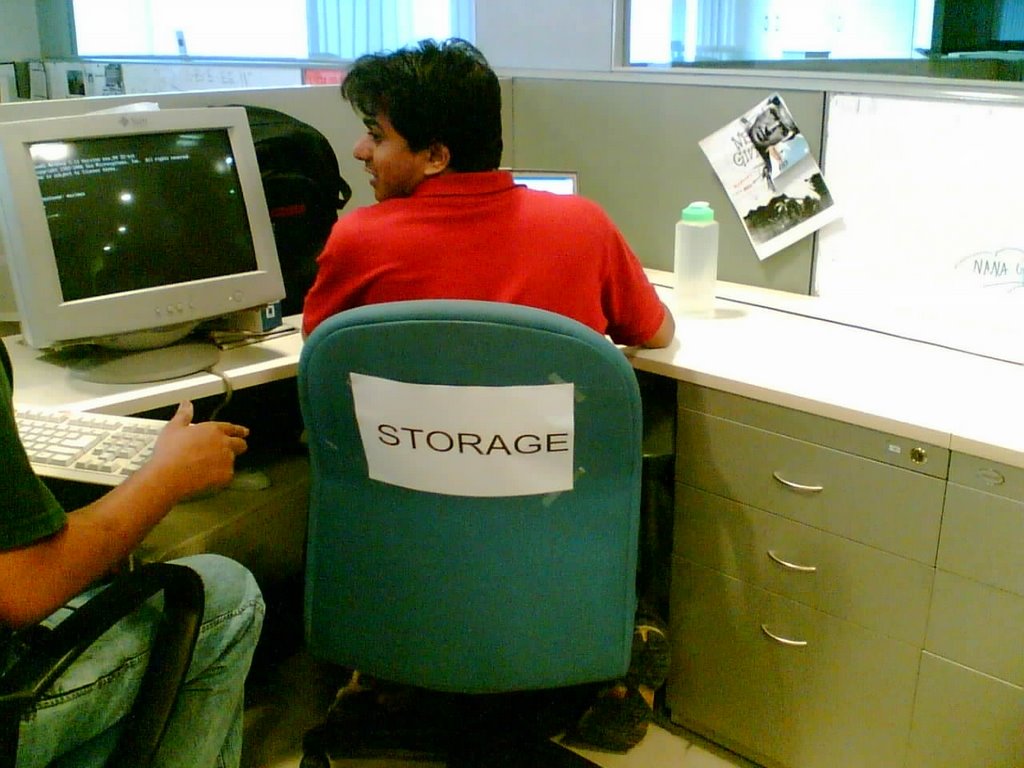
Fun @ my workplace

My friends @ SUN , Murtaza and Vikash have taken the literal meaning of my blog address and have cliked a picture (without my knowing), that expresses the same.


Thursday, September 14, 2006

News :: SRM Software,SUN-STK Business Analytics wins Best Storage Resource Management Software award at Big Bytes Storage Expo awards(Byte n Switch)

It really feels great when the product that you are working for gets rewarded by an open body storage publication for good work. I am talking about SUN-STK Business Analytics Software that won the Award for Best Storage Resource Mgmt software at the Big Bytes Storage expo at Burlingame , California . Catch the news at -> http://www.byteandswitch.com/document.asp?doc_id=1...

Monday, September 04, 2006

Concept :: Volume Management on Linux ?? -> EVMS , LVM2

Hey guyz !!! If you are lookin for Volume Management on Linux , then the EVMS (Enterprise Volume Management System) and LVM2(the successor of LVM) are a good read. It is pretty interesting to see how both of them use the newly added DM(Device mapper , introduced in Linux Kernel 2.6.x). The device mapper itself is interesting , as the entire multipathing logic/support has been added here.

The multipathing support revolves around what are known as "priority groups" . These priority groups contains a list of paths to follow for each device path in the storage environment. The paths from each of the groups are selected in a round-robin fashion so as to facilitate I/O load balancing and high availability . Pretty cool !!

U can look at :

http://www.linuxjournal.com/article/5957

http://evms.sourceforge.net/

http://www-128.ibm.com/developerworks/linux/librar...

http://sourceware.org/lvm2/

Wednesday, August 30, 2006

My first blog post !!!

HI guyz !! This is my first post to the blog and i m really excited to post here . Microsoft have come up with a cool tool called "Windows Live writer" which you can download from http://www.download.com/3001-2068_4-10572481.html

Its a writer program that helps you publish feature rich content to blogs without the hassle of executing multi-click steps of writing to a blog . Have to say it is a handy tool !

Anyways , i m finally writing to this blog after much ado . It feels really nice to be back to blogging !! I used to blog at Yahoo360 and @ my organisational blog @SUN both of which you can still catch at

http://360.yahoo.com/gocoolkrish

http://blogs.sun.com/gocoolkrish

I hope to make this blog a write-up about the technologies and components in the Storage World that interest me . I would be putting up articles related to storage , basic glossary/definitions for newbies to storage and latest buzzwords/technologies that rock the storage world..So keep in touch and hope to c u soon back again !